
The Importance of Voting, Now More Than Ever
So what’s next in the fight for reproductive rights?
Everybody’s faaaavorite topic, of course: the 2024 election!
I hope you read that with dripping sarcasm, because I definitely acknowledge that many of us are already tired of talking about it. It’s one of the most divisive topics in the country, now more than ever, but that’s why it’s imperative that we keep talking about it. Without a doubt, this election is shaping up to be one of the most crucial elections in modern history.
I’ve had many conversations over the years about our elections – at all levels, including local, state, and national – and the problems that are brought up, including why so many people simply don’t vote.
For some, its about the choice of candidates themselves. In a poll conducted by YouGov after the 2022 congressional election that allowed participants to select multiple reasons for their voting decisions, over 52% of participants stated that they didn’t vote because they didn’t like any of the candidates.
For some, it came down to logistics. 48% of non-voters stated that they didn’t vote because they were too busy. Roughly two in five cite each of several logistical concerns: a lack of transportation to the polls (41%), being required to vote in person (39%), or not knowing how or where to vote (36%). Voter registration also keeps some from voting: 28% cite as a reason for not voting the fact that they’re registered in a different state, 28% cite missing the deadline to register, and 27% cite not knowing how or where to register.
And for others, it was a matter of apathy. 48% of non-voters stated that they chose not to vote because they didn’t believe their vote would matter.
According to Michael P. McDonald, a professor in the department of political science at the University of Florida “Deciding not to vote is not an uncommon stance in America. In recent decades, the number of eligible people who vote for president has hovered between 50% and 60%”
And that’s for the national Presidential elections – this doesn’t take into consideration that off-year elections and primary elections have an even lower voter turnout.
According to States United Action, a nonpartisan nonprofit organization with a mission to protect election integrity, North Dakota voter turnout for primary elections has averaged around 22.17%.
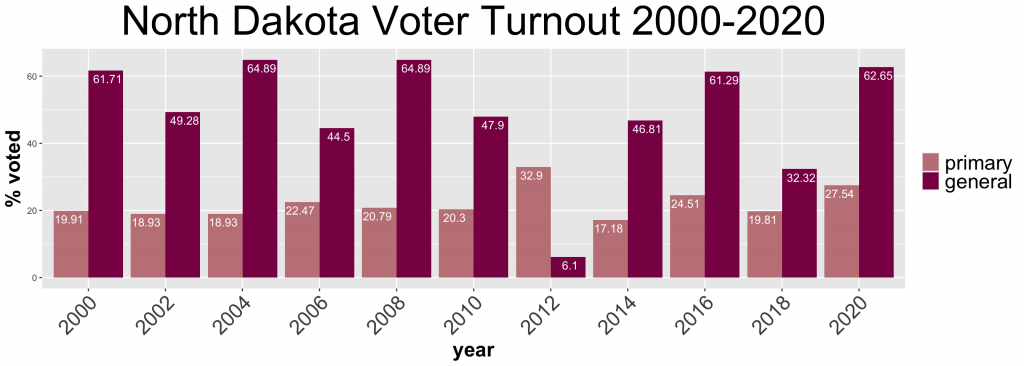
I wonder what these elections would have looked like if more people voted? Furthermore, how would have that changed our current state of affairs?
For primary elections, it’s not just about determining which candidates compete in the general election, such as who runs for Governor or state legislature. It’s also when we vote for our local leadership – city council, county commission, judicial positions, school board members, and proposed ballot measures. These are crucial choices that determine some of the most impactful decisions that are made in our cities and counties.
Off-year elections are also important, because we still vote for federal representatives in the U.S. House and Senate, North Dakota state legislative candidates, along with other state offices such as Attorney General, Secretary of State, the North Dakota Supreme Court and other local ballot measures.
The right to vote is one of the most basic rights given in our democracy, and the Minot Women’s Network holds that promoting our right to vote is a crucial step in protecting our reproductive rights. We work in conjunction with organizations such as the League of Women Voters to advocate for protection of voting rights, education through informed voting initiatives, and efforts to improve voter turnout in order to achieve the outcomes that we demand from our elected representative. North Dakota is currently the only state in the country that does not require voter registration – a key factor in ensuring that people can easily vote. In the upcoming months, you will see a lot of information from us on topics such as candidate stances, ballot measures, finding your polling place, how to cast an absentee mail-in ballot, early voting, and more.
Our elected officials work for us, and its imperative that we hold them accountable for their actions in office. Turning out to vote for the representatives that we believe will protect the things most important to us is one of the key foundational actions that we can take to enact long-term, powerful change in North Dakota. It’s not just about voting for President – it’s about our local and state elections, too. From city council all the way up to our state legislators, our futures are impacted by who we vote for – and just as importantly, by who we don’t vote for.
